

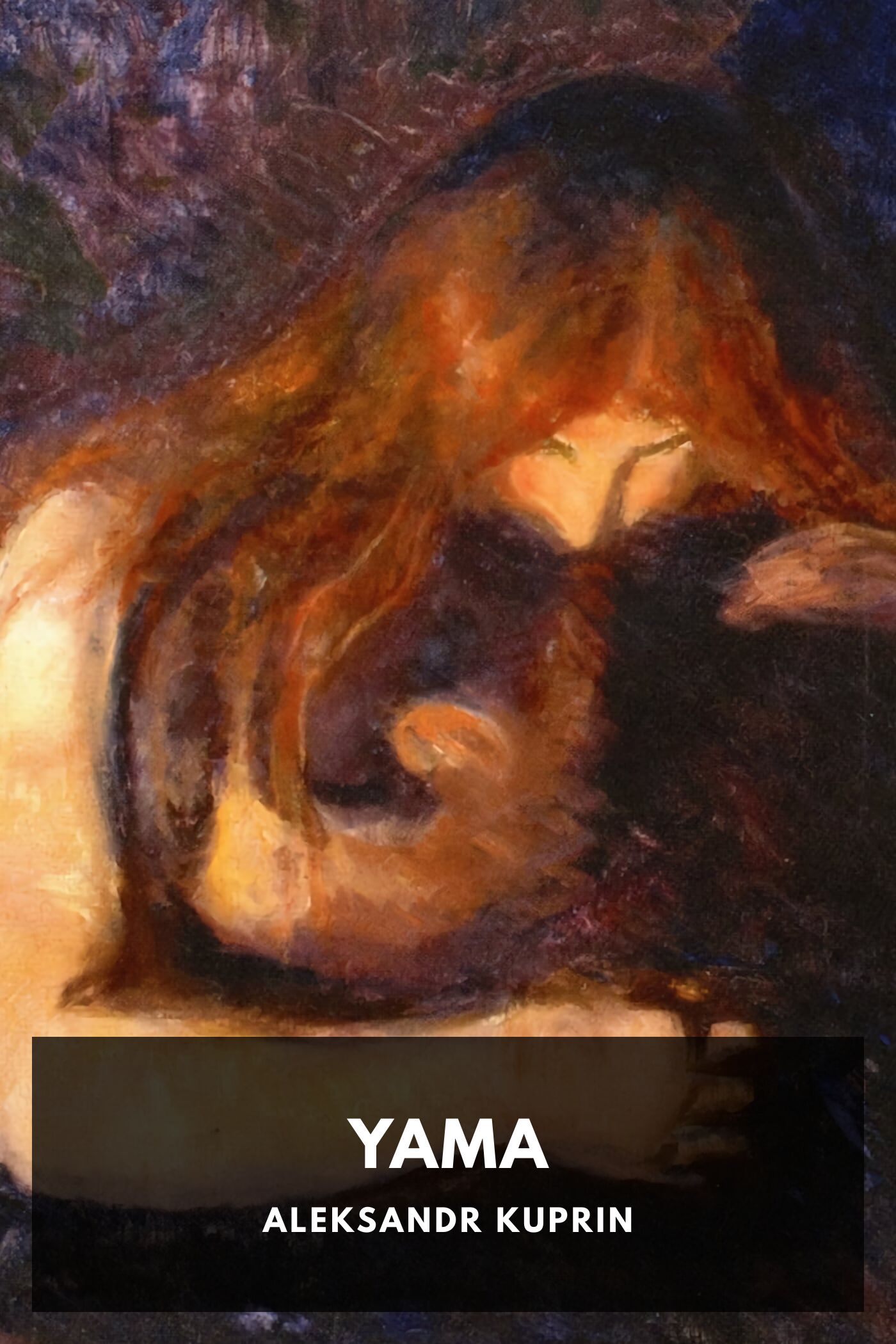
About this book
Yama ( The Pit ) recounts the lives of a group of prostitutes living and working in Anna Markovna’s brothel in the town of K⸺. The women, subject to effective slavery through the removal of their papers and onerous debts, act out a scene of easy affability every evening for the part ignorant, part monstrous clients, while keeping secret their own pasts and wished-for futures.
The book was Kuprin’s attempt to denormalize the cultural ambiguity of the legal brothels of the time. His dedication—“to mothers and youths”—expresses his desire that there should no longer be a silent acceptance of the actions of the “fathers, husbands, and brothers.” The novel was notable for portraying the inhabitants of the brothels as living, breathing people with their own hopes and desires, not purely as a plot point or scenario.
The critical response was mixed: many found the subject matter beyond the pale. Kuprin himself placed his hopes on a favourable review from Leo Tolstoy , which didn’t come; but there was praise for Yama as both social commentary and warning, and an appreciation for Kuprin’s attempt to detail the everyday lives of his subjects.
The novel had a troubled genesis, with the first part taking nine years between initial proposal and first publication; the second and third parts followed five years later. It was a victim of the Russian censors who, tellingly, disapproved more of scenes involving officials visiting the brothels, than the brothels themselves. It was only later during preparations for an anthology of his work that an uncensored version was allowed to be released. This edition is based on the translation to English by Bernard Guilbert Guerney of that uncensored version, and was first published in 1922.
Book Details
- Print length
- 471 pages
- Language
- English
- Publisher
- Standard Ebooks
- Publication date
- December 21, 2020
Yama
Aleksandr KuprinMore from Aleksandr Kuprin
More from Fiction

Moby Dick
Herman Melville

A Room With a View
E. M. Forster

Crime and Punishment
Fyodor Dostoevsky

Alice’s Adventures in Wonderland
Lewis Carroll

The Count of Monte Cristo
Alexandre Dumas

Middlemarch
George Eliot

The Blue Castle
L. M. Montgomery

The Adventures of Sherlock Holmes
Arthur Conan Doyle

Jane Eyre
Charlotte Brontë

The Mysteries of Udolpho
Ann Radcliffe